
Home Guides 7 Money-Saving App Categories Worth Installing
7 Money-Saving App Categories Worth Installing
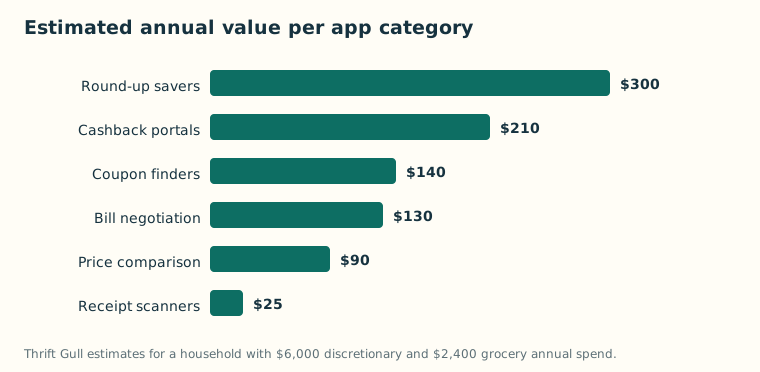
Your phone can be a money-saving machine or an impulse-purchase portal, and the difference is almost entirely which apps you install. The app stores list thousands of "money" apps, but nearly all the genuine value sits in seven categories — and crucially, you need at most one app per category. Two overlapping apps don't save twice; they split your attention and double your notification load until you ignore both.
Here's each category, what a good app in it actually does, and how to choose.
1. Budget trackers
The foundation. A budget app connects to your accounts, categorises spending automatically and shows where the money went — which sounds basic until you realise most people have never seen their true monthly grocery or takeaway total. Choose on one criterion: will you open it weekly? The best app is the one whose interface you don't dread. Automatic bank syncing is worth paying for if manual entry would kill the habit; a spreadsheet you update beats an abandoned premium subscription.
2. Price comparison
Barcode scanners and price-history trackers answer the only question that matters in a shop: is this actually a good price? Price history is the more powerful half — many "deals" are routine prices with theatrical labels, and a history chart exposes the theatre instantly. Use it before any purchase over about $50.
3. Cashback portals
The portal's own app solves the biggest weakness of portal cashback: forgetting to click through. Mobile apps with in-app browsers or browser extensions with activation reminders remove the memory step. This is the top layer of the system in our cashback stacking guide — if you adopt only one category from this list, make it this one.
4. Receipt scanners
Photograph receipts, earn small rebates or points. The honest framing: this category pays pennies per receipt and is worth it only if scanning takes under ten seconds and you'd discard the receipt anyway. Treat it as monetising rubbish, not as income, and it stays in healthy perspective.
5. Coupon and deal aggregators
These test promo codes at checkout and flag price drops on watched items. Genuinely useful for planned purchases — pair them with the list discipline from our meal planning system for groceries. The trap is the push notification: a "deal" alert is advertising wearing a savings costume. Turn notifications off and check the app only when you already intend to buy.
6. Bill negotiation and subscription finders
These scan your accounts for recurring charges and either flag them for you to cancel or negotiate bills on your behalf for a cut of the savings — typically 30–50% of the first year's reduction. The subscription-finding half is excellent and largely automates step one of our subscription audit. The negotiation half is fine value if you'd never make the call yourself; if you will, keep the whole saving with the script in that article.
7. Round-up and micro-saving apps
Every card purchase is rounded up and the spare change swept into savings. The amounts are small — $20–$50 a month for typical spending — but the category's real product is the default: money saved before you could spend it. Check the fee structure carefully; a $3 monthly subscription can eat a meaningful slice of $30 in round-ups, and some challenger banks now bundle the same feature free — see our digital banks comparison.
Choosing one per category
Four filters settle most decisions quickly:
- Business model: free apps are funded by your data, by interchange or by referral. Decide which you're comfortable with before connecting accounts.
- Data access: prefer apps using regulated open-banking connections over ones asking for your banking password. Never share raw credentials.
- Exit cost: can you export your history? An app that holds two years of your data hostage owns your switch decision.
- Notification hygiene: if an app's default settings alert you more than your bank does, fix the settings or delete the app.
Install deliberately, audit quarterly, and delete ruthlessly. A phone with seven well-chosen money apps quietly returns hundreds a year; a phone with thirty of them mostly returns notifications.